
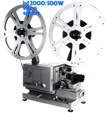

As its name suggests a projector projects all the information that it receives onto a screen. When you go to a cinema, you are watching the image which is being projected onto the screen with the help of a projector. A movie projector is very similar to a slide projector, the only difference being that in a slide projector each frame is displayed individually. A movie projector works on the principle of "phi phenomenon" or optical illussions. The frames are projected one after another at such a great speed that it produces an illussion of movement, and hence the word "movie".

The earliest type of projectors were the 8mm and 16mm projectors. They were used when movies were recorded on the 8mm or 16mm film. In those days projectors were not really used for the home entertainment market for one simple reason, there was no home entertainment market. Movies were just being launches and the only reason someone would have an 8 or 16mm projector in his house was that they were somehow involved in the movie business. Now of course they are tools used by movie buffs. People who like to call themselves collectors of art and movies. Of course they are also used by psychopathic rapist as nic cage found out, but thats a different matter. A typical projector had a xenon bulb of about 500 - 1000 watts which projected the image and a 30 watt amp with it. Of course you need a separate power plug for the lamp house which will give it the extra energy it requires while starting up. Below are the specs of a 16mm projector by Fumeo. It will give everyone an idea of what the projector was like.
FUMEO HL3000/1000W
The HL3000/1000W was fitted with the 1000W horizontal Xenon lamp, having a performance of more than 3000 lumens, well able to project an image up to 14 m (42ft) from 40m (120ft).
9342/30
30 Watt amp
9343/OM30
plus Magnetic playback
9344/40
Modular electronic amp + option for 40 Watt amp
9345/OM40
As above but with Magnetic playback

Until the 60’s and early 70’s it was really impossible for a patron of movies to find anything for sale or rental as far as big names go. Only Universal Pictures had some movies out and those too were only available for rental in a one reel black and white version. It was only in 1973 or thereabout that the home market really kicked off with the introduction of digest versions of many movies from MGM and 20th Century Fox. These were selected scenes from their movies with the help of a voice over of a narrator which filled in the gaps. This lasted a few years before the introduction of beta and vhs in the 1980’s. Fortunately for collectors Derann are still releasing films from a couple of the major studios, they release from 20th Century Fox, MGM, Walt Disney. The occasional rare titles also turn up from around the world.
Below are some of the companies involved in Super 8mm films over the years:
Walton Films, Powell Films, Iver Films, DCR Films, PM Films, Perry's Movies, Derann Film Services, Ivy Films, Famous Films, Blackhawk Films, Niles Cinema, Red Fox Films, Thunderbird, Gaines, Hollywood Film Exchange, The Film Office, Marketing Film
International, Piccalo, Ken Films, Dave Thomas Films, Halco Films, LA Films, Independent 8, Major 8 Movies, Classic Home Cinema, Jef Films, Arrow Films, Enfield Film Services, Starwood Films, Amba Films, Kodak, Agfa, Movieland, Looney Movies, CEC.

With the introduction of home theatres in almost every house people are looking for the optimum level of viewing pleasures. This caused a lot of people to be unsatisfied with the normal display of a vhs, LD or DVD hooked upto their TV. They wanted bigger screens and they wanted to make sure the image was not distorted in any way. That was how the 3 tube projector came into the home entertainment market. Once you plug your VCR, LD or DVD player into the projector it will project the image onto the screen in front of it. It had the blue, green and red tube through which it projected the colours and hence the name. The advantage of this was that you could use a screen as large as 250 inches without any problem at all. With a TV antenna inside you can also see any TV show you want.

The LCD projector is the ultimate in projection technology. It usually uses a Metal Halide Lamp as its light source to project the information received by it onto the screen in front. It's an ideal light source because of its color which is close to that of the sun and very white. The newer models of LCD projectors however use a UHB Lamp. UHB is the acronym of Ultra High Brightness. It requires relatively lower power to get the same brightness as Metal Halide. Although used in the home theatre market, the LCD projector is found more in business operations, which use it as a source of presentation. This is largely due ot its compatiblilty with computers. The advantage if an LCD projector is that its a lot lighter and smaller than a 3 tube projector. Also the picture quality is alot better. Plus if you want you can hook your computer onto it. Imagine playing Quake on a 250 inch screen! The clarity of the projector depends on its resoluton. The LCD projector's resolution depends on the number of pixels it can display.

The life of projectors in the home theatre market might soon come to an end. From christmas ‘98 Plasma Display Monitors have been available for consumers to buy. The Plasma Display Monitrs are mainly made by Phillips and Pioneer. They are available 42 inch and up. Plasma Displays complicated structure of the cell is all contained within a diminutive 0.808mm X 0.858mm shell. Cells function through the application of electric charges to rare gases contained within. Charges produce ultraviolet radiation which energizes phosphors causing them to emit light, generating visible radiation that emerges through the front of the color PDP's face glass substrate, combining with the light from
adjacent pixels to create an image.
With its revolutionary technology, Plasma Display Monitors are extremely slim and extremely light. The Pioneer's Plasma Display inch screen had a depth of 3.88 inches and a weight of 94.7 lbs.
One main difference between a front-projection system and a rear-screen projection system, therefore, is the viewing angle. Anyone who has shopped for a rear-screen projection system or looked at a notebook's direct-view LCD panel knows that the device's image looks best when viewed straight-on and can look different when viewed at an angle. The width of the angle at which the display can be viewed and still look good is called the viewing angle. The PDP has a veiwing angle of 160 degrees.
